
Beyond the Chatbot: How Claude Code Is Turning Security Audits Into a One-Command Workflow
Repository: https://github.com/ch0ks/hackarandas-claude-toolbelt
 Every seasoned DevSecOps lead knows the “security tax”: the grinding friction between a high-velocity engineering team and a security team buried under vulnerability fatigue. We’ve all seen the cycle: a static scanner dumps a thousand-line PDF of potential leaks, a developer spends days triaging what actually matters, and then comes a messy stream of manual remediation PRs that often break the “vibe” of the codebase. In that triage-to-remediation gap, security posture quietly decays.
Claude Code flips the script. It’s not just a chatbot; it’s an agentic assistant that can run a sophisticated, end-to-end security pipeline directly from your terminal. By shifting the focus from “tools that find problems” to “agents that solve them,” Claude Code moves the signal-to-noise ratio back in favor of the defender.
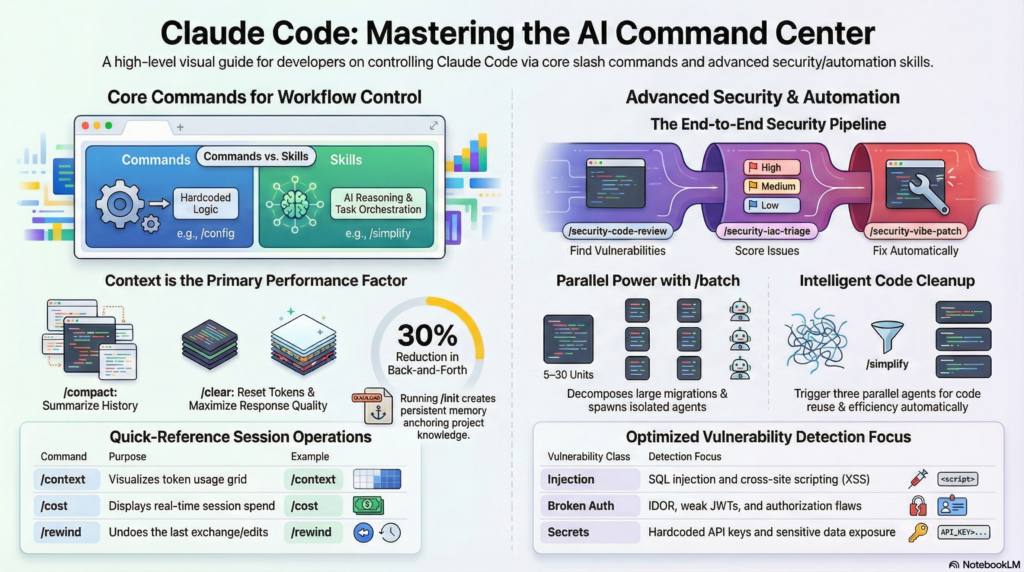
Commands vs. Skills: The Hidden Architecture
At first glance, typing / in Claude Code feels like using a standard CLI. But there’s a subtle, important distinction between a “command” and a “skill.” Commands are hardcoded, fixed-logic operations—administrative tools like /clear or /config that don’t involve AI reasoning.
Skills, though, are something else entirely. They are prompt-based capabilities defined in Markdown files, effectively giving Claude a “playbook” of instructions. A skill doesn’t just run a script; it can spawn sub-agents, invoke specialized tools, and orchestrate multi-step workflows across your codebase and infrastructure.
Building a SAST Pipeline in Your Terminal
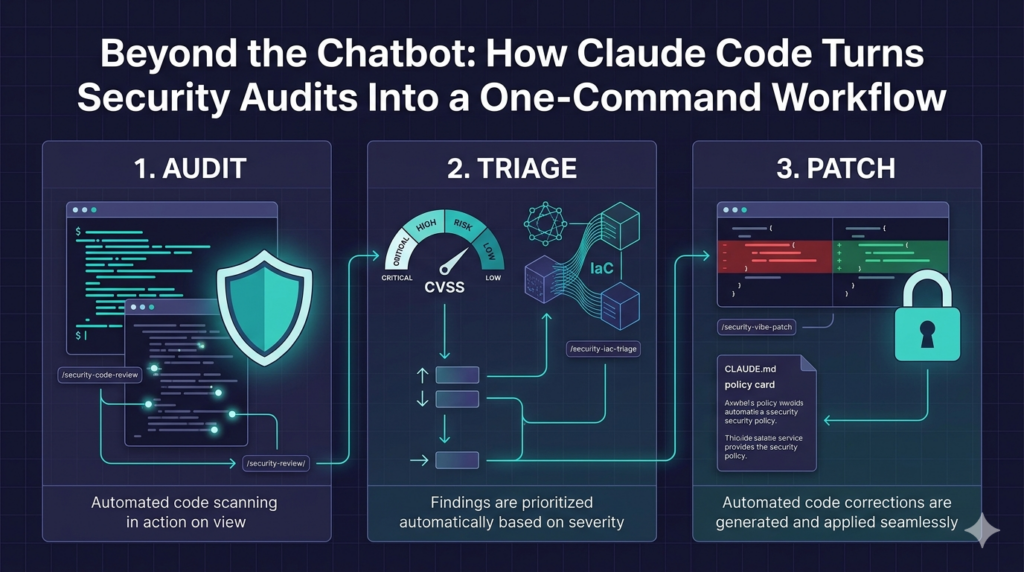
The real power comes from chaining three specialized skills into an end-to-end security pipeline:
/security-code-review
Orchestrates a full audit by combining Semgrep Pro’s interprocedural taint analysis with a manual-style vulnerability assessment. It produces a formal report covering injection risks, auth flaws, cryptographic issues, dependency risks, and OWASP Top 10 (2021)-style coverage.
/security-iac-triage
Once findings are surfaced, this skill triages them by grounding CVSS 4.0 scores in your actual Infrastructure-as-Code (Terraform, Kubernetes, CloudFormation, Docker Compose, Azure Pipelines). It answers the critical question: Is this vulnerability actually exposed to the internet, or is it sealed behind internal network rules?
/security-vibe-patch
The final step is remediation. This skill reads the security report and generates minimal, precise patches. Following the “Vibe Security Patching” methodology, it makes the smallest possible change to fix the bug—without refactoring your entire codebase or rewriting comments.
The Agentic Pipeline: From Audit to Patch
Typical AI tools give you isolated snippets. Claude Code, by contrast, orchestrates an end-to-end “Agentic Pipeline” using these three skills.
When you run /security-code-review, Claude acts as an Expert Security Engineer. It doesn’t just invoke Semgrep Pro; it layers manual-style analysis on top, performing interprocedural taint-tracing across six critical classes:
- Injection & taint flows (e.g., HTTP headers, cookies, DB results flowing to dangerous sinks).
- Authentication & authorization (IDOR, JWT algorithm confusion, broken access-control patterns).
- Secrets & sensitive data (hardcoded credentials, PII exposure).
- Cryptography (weak algorithms, timing-vulnerable comparisons).
- OWASP Top 10 (2021)-style coverage.
- Dependency risks (deprecated or vulnerable imports).
All artifacts—SAST reports, IaC mappings, and patch diffs—are centralized in a /security-review/ directory at the repo root, so each stage of the pipeline reads the verifiable output of the previous one.
Grounding CVSS 4.0 in Infrastructure “Ground Truth”
The biggest credibility killer for AI security reports is the “unreachable sink”—flagging a critical vulnerability in a service that isn’t even internet-facing. Claude Code eliminates this noise via /security-iac-triage.
Claude doesn’t guess at severity. Instead, it hunts through your Terraform, Kubernetes, Docker Compose, CloudFormation, and Azure Pipeline files to surface deployment signals and map them directly to CVSS 4.0 vectors like Attack Vector (AV), Privileges Required (PR), and Attack Complexity (AC). Key signals include:
- Network exposure: Ingress rules (
0.0.0.0/0), internet-facing load balancers, mapped host ports. - Auth controls: IAM roles, Cognito-style identity providers, WAF-protected endpoints (which increase AC).
- Secrets management: Distinguishing weak patterns (e.g., base64-encoded K8s secrets) from strong providers (AWS Secrets Manager, HashiCorp Vault).
You also control the team’s risk posture via a Scoring Posture:
| Posture | When to Use | Assumption for Unknowns |
|---|---|---|
| Strict | Compliance audits, pen-test prep | Assume worst-case for all unknowns |
| Standard | Sprint reviews, pre-merge checks | Infer from IaC context |
| Lenient | Internal tooling, early-stage projects | Absence of evidence = low risk |
This ensures different projects can apply the same pipeline at different risk dials, without sacrificing rigor.
“Vibe Patching” and the Self-Corrections Loop
Typical AI remediation can lead to “refactoring sprawl”—rewriting an entire class to fix a single null-pointer exception. Claude’s /security-vibe-patch skill embraces a minimalist philosophy: fix the vulnerability without deleting a comment or reordering control flow unless absolutely necessary.
The workflow is meticulously atomic:
- Isolated branches: Each patch lives on a dedicated
security/vibe-patch-YYYYMMDDbranch. - Atomic commits: One commit per finding, with embedded CWE, finding ID, and Semgrep rule ID for traceability.
Then comes the verification loop: after applying a patch, Claude re-runs Semgrep. If the finding persists, it attempts a second, revised patch. If confidence remains low, it skips the patch entirely and marks it as “Manual Review Required” in the final PR. This prevents false confidence and ensures only high-confidence fixes land automatically.
Encoding Security Policy into CLAUDE.md
A security assistant is only useful if it follows your house rules. Through the /init command, Claude Code creates a CLAUDE.md file that acts as the repository’s persistent memory.
While this file tracks tech stacks and naming conventions, its most powerful role in security is as a Secure Development Policy. You can encode project-specific rules like:
- “Always use
hmac.compare_digestfor security-sensitive comparisons.” - “Ensure all S3 buckets reference the
private_bucketTerraform module.”
Because Claude reads this at the start of every session, it reduces clarification back-and-forth by roughly 30% and ensures that every patch it generates aligns with your team’s security standards from the very first turn.
Real-World Impact: The Azkaban Case Study
To see these skills in action, consider a recent security remediation on the Apache Azkaban repository. A security review identified a critical XXE injection vulnerability (FINDING-001) and a set of hardcoded credentials (FINDING-006).
Running the automated pipeline produced:
- A Security Code Review Report (SCR-20260406-001) mapping the risks.
- A Security Vibe Patch Report (SVP-20260406-001) documenting the fixes.
The result was a structured Pull Request (RozulIO/azkaban/pull/1) that replaced default credentials with placeholders and disabled dangerous XML features with just six lines of defensive code. Every patch reads like something an engineer would be proud to merge—clean, minimal, and correct.
Deep Analysis for All: Semgrep Pro’s Free Tier
A key engine behind these skills is Semgrep Pro, which provides advanced interprocedural taint analysis—tracing data from an untrusted source (such as a URL parameter) all the way to a dangerous sink (like a file system call).
While these capabilities were once reserved for large enterprises, Semgrep now offers a free tier for teams of up to 10 monthly contributors, including access to high-confidence “Pro Rules” and the advanced engine. This means even solo developers can run enterprise-grade security checks directly from their Claude Code sessions.
How to Adopt These Skills Today
You can implement this exact security pipeline in your own environment. A GitHub project provides the skill definitions and templates ready for adoption:
https://github.com/ch0ks/hackarandas-claude-toolbelt
To install them:
- Clone the repository.
- Copy the skill folders into your global Claude configuration directory:
~/.claude/skills/<skill-name>/SKILL.md.
Once in place, Claude Code will automatically discover them, and you can begin securing your projects by simply typing /security-code-review in your terminal.
The Future of Autonomous Security
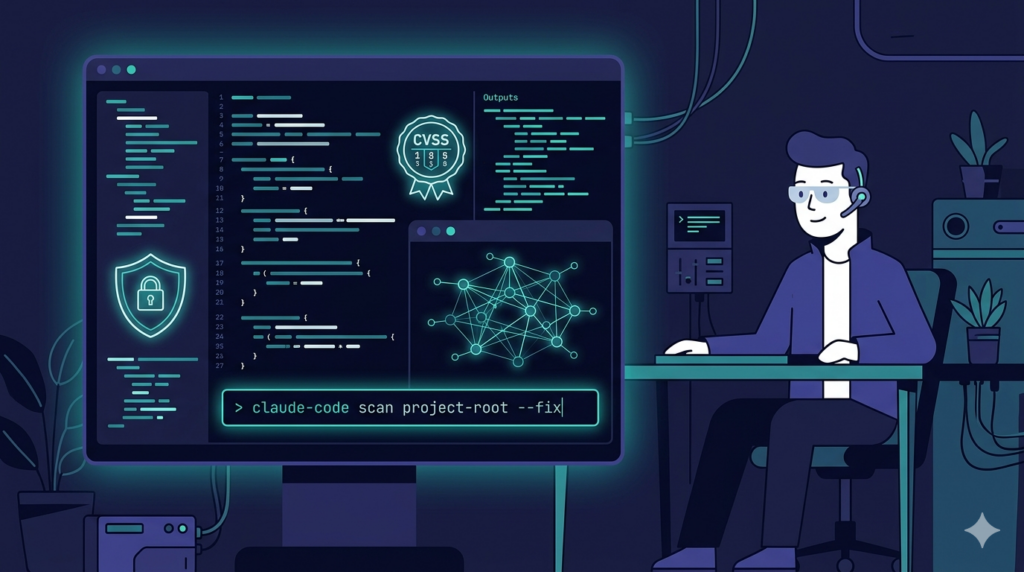
The shift with Claude Code is fundamental: we’re moving from “tools that find problems” to “agents that solve them.” By grounding its reasoning in your infrastructure and maintaining a strict, minimalist approach to remediation, Claude Code effectively turns the developer’s terminal into a high-fidelity security operations center.
As these agentic workflows become standard for pre-merge checks, the role of the traditional security auditor will evolve. The question for every developer is no longer whether vulnerabilities will be caught—but how early and how automatically they can be remediated. If your terminal can already scan, score, and patch your vulnerabilities with high confidence and minimal friction, how much faster could you move—and how much safer could your applications become?