
Lessons Learned Running My Second Corporate CTF: Simpler Infrastructure, More Drama, and the Human Side of Security
Or: how I learned that managing a hundred people competing for gift cards can be harder than managing a bunch of intentionally vulnerable applications.
TL;DR: My second corporate CTF taught me that simplifying infrastructure is much easier than managing human behavior. I replaced an overengineered AWS setup with a single EC2 instance running Docker, Traefik, and Let’s Encrypt, while introducing custom mascots, storytelling, and 104 challenges to make security awareness more engaging. With 134 registrations and 83 active players across six countries, the event was a success, but monetary prizes introduced unexpected friction between teams, amplified by differences in purchasing power across regions. Stronger rules helped manage disputes, but the biggest reward came from a manager’s email explaining how the CTF helped their team build relationships, collaborate, and have fun at work. The biggest lesson? A successful CTF isn’t just about hacking. It’s about people, teamwork, and making security education memorable.

Last year, I wrote about the lessons I learned organizing my first corporate Capture the Flag. It was an interesting experience that taught me a lot about infrastructure, security awareness, teamwork, and, unexpectedly, office politics. Despite a few headaches, the event was successful enough that I decided to organize another one for Security Awareness Month in October 2025.
I figured things would be easier the second time around. After all, I had already made plenty of mistakes, learned from them, and had a pretty good idea of what to expect. I knew how to build the platform, what kind of challenges people enjoyed, how to encourage participation across our international offices, and which rules needed to be established before someone decided to get creative with the competition.
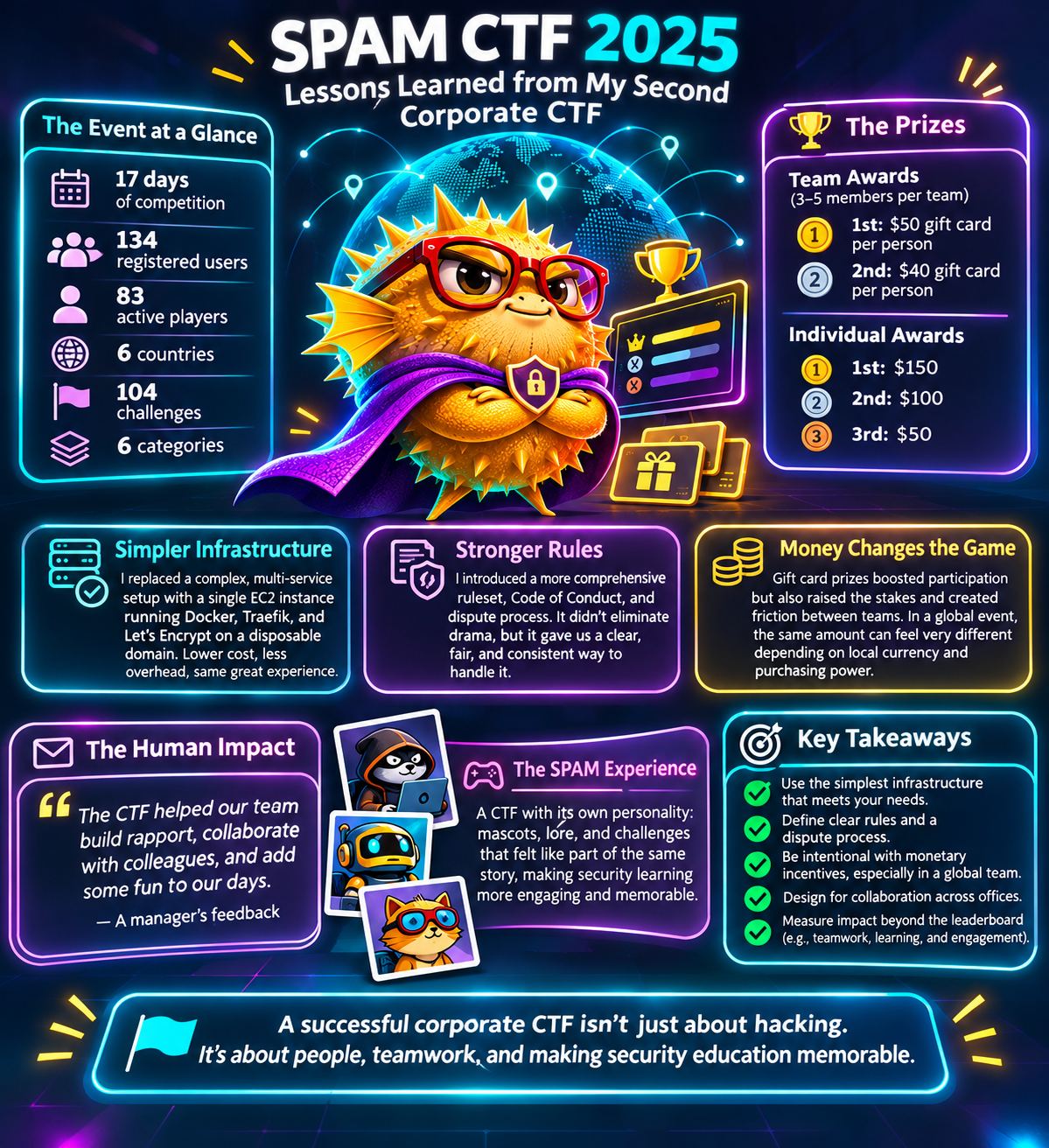
And in many ways, I was right. The technical side was considerably easier. I simplified the infrastructure, improved the organization of the challenges, introduced more personality into the event, and established a much more comprehensive set of rules. We ended up with 134 registered users, 83 active players from six countries, and 104 challenges across six categories during a 17-day event.
What I underestimated, once again, was the human element. Running a CTF isn’t only about finding vulnerabilities and solving puzzles. When you introduce competition, monetary incentives, international teams, and a leaderboard, you also introduce expectations, different interpretations of fairness, and the occasional disagreement that has absolutely nothing to do with cybersecurity.
Here is what I learned from organizing my second corporate CTF.
1. I Stopped Overengineering the Infrastructure
For my first CTF, I decided to use the opportunity to refresh my infrastructure engineering skills. I built a relatively sophisticated AWS environment using Terraform, managed container services, a managed relational database, Redis, load balancers, and all the supporting components. It worked well, and I enjoyed the experience, but looking back, it was considerably more infrastructure than the event actually needed.
This time, I approached the problem differently. Instead of asking myself what architecture would be interesting to build, I asked what architecture would be sufficient to support around a hundred participants for a couple of weeks.
I ended up choosing a single EC2 instance running Docker, with CTFd handling the competition, MariaDB providing persistent storage, Redis supporting the application, and individual Docker containers hosting the vulnerable challenges. I also used Portainer to make container management easier. There was no need for Kubernetes, EKS, or managed databases. Everything could run on one machine, and I could concentrate on the event instead of maintaining a small collection of cloud services.
For sizing, I selected an m7i-flex.2xlarge instance with 8 vCPUs, 32 GiB of RAM, and 100 GB of gp3 EBS storage. The initial estimate for compute and storage was approximately $288 for an entire month, excluding some supporting AWS services. It was a reasonable budget for an ephemeral environment, particularly compared to the cost and administrative overhead of more complex architectures.
Making It Accessible Without Connecting It to the Company
One important requirement remained unchanged from the first year: the CTF needed to be accessible from anywhere in the world without requiring access to the corporate VPN. Some of our colleagues, especially those outside engineering, don’t need a VPN for their daily work. Requiring one just to participate in a security awareness activity would have excluded part of the audience I was trying to reach.
Because the platform needed to be exposed to the internet, I registered a disposable domain unrelated to the company’s identity. I didn’t want an intentionally vulnerable collection of applications associated with a corporate domain, even indirectly. The disposable domain provided a separate identity for the event and could be retired once the competition was finished.
For ingress, I used Traefik as the reverse proxy with Let’s Encrypt for TLS certificates. This was another simplification compared to the previous year. Traefik integrates nicely with Docker and allows routing to services based on container configuration, which made managing multiple challenge applications easier. Let’s Encrypt handled the certificates without requiring me to manually provision and maintain them.
Of course, TLS and an unrelated domain don’t make vulnerable applications safe. The environment still needed to be isolated from corporate infrastructure, and the intentionally vulnerable containers had to be treated as untrusted workloads. The domain separation reduced the association with the company’s public identity, but isolation and proper access controls remained the real security boundaries.
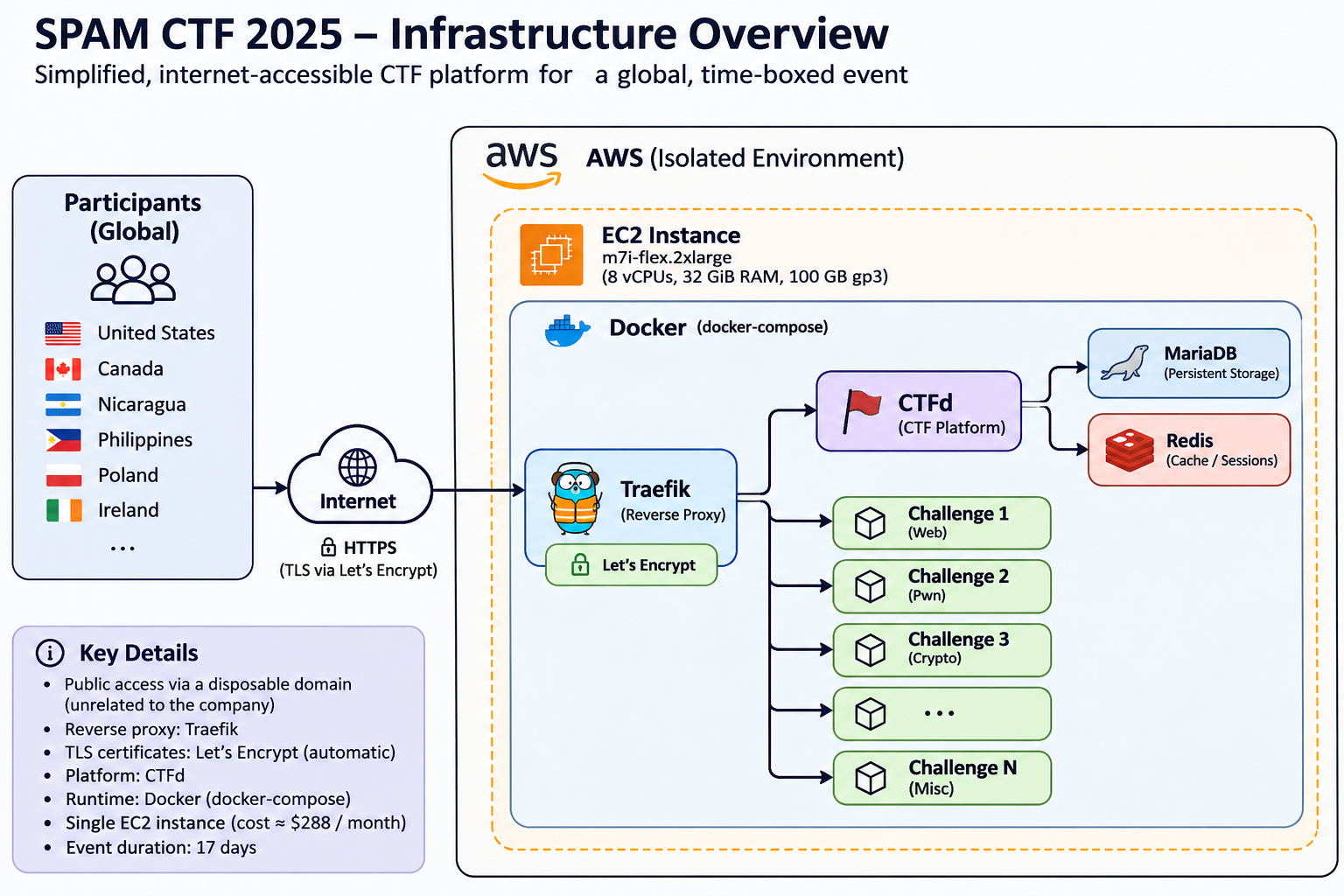
The architecture did introduce a single point of failure, but I considered that an acceptable tradeoff for a short-lived, internal training event. I wasn’t running a payment processing system, and the business wasn’t going to collapse if the CTF scoreboard became unavailable for a few minutes.
The biggest improvement wasn’t necessarily the lower cost. It was the reduction in operational complexity. Instead of spending my evenings troubleshooting cloud infrastructure, I could spend that time reviewing challenges, helping contributors, and improving the participant experience. As someone organizing this on top of my normal responsibilities, that was far more valuable than having an impressive architecture diagram.
The lesson: Complexity should be justified by requirements, not by the technologies you happen to know. Sometimes a single EC2 instance and Docker are exactly what you need.
2. Security Awareness Should Have a Personality
One thing I wanted to improve was the overall competition experience. Corporate security awareness activities sometimes suffer from a particular problem: they feel like corporate security awareness activities. You know the type. A presentation full of compliance requirements, a few slides about phishing, and a quiz that everyone completes because someone in management told them to.
I wanted something different.
For SPAM 2025, I spent more time developing the visual identity of the CTF. We had our own mascots, a recognizable color palette, a customized CTFd interface, and characters that became part of the event’s personality. Instead of treating the challenges as isolated technical exercises, I started incorporating them into the lore surrounding those characters.
SPAM, our Security and Privacy Awareness Month, became more than the name of the campaign. It became the setting for the competition.
This might sound like an unnecessary detail, especially to someone who only cares about the technical quality of the challenges. But I think the presentation of a learning experience matters more than we sometimes recognize. A SQL injection challenge can be another intentionally vulnerable login form, or it can be part of a small story involving a character that participants have already encountered elsewhere in the event. The underlying vulnerability is the same, but the experience is different.
The mascots and their stories also helped connect technical and non-technical challenges. Not everyone was interested in exploiting web applications, but participants could still engage with the event through quizzes, security scenarios, presentations, and other activities. The common theme made these different experiences feel like parts of the same competition instead of a random collection of training exercises.
I also wanted people to remember the experience after Security Awareness Month ended. The mascots, the visual identity, and the silly references throughout the challenges gave the event a personality that a regular CTF installation wouldn’t have provided.
There is a practical security awareness lesson here. We often spend a lot of effort ensuring that our educational content is technically accurate, but considerably less effort making it enjoyable. Accuracy is essential, but engagement is what gets people to actually interact with the material.
The lesson: Make security education memorable. A little creativity, some character lore, and a ridiculous mascot can do more for engagement than another fifty slides about security policies.
3. Better Rules Don’t Eliminate Drama, but They Help You Control It
If there was one thing I was determined to improve after my first CTF, it was the rules. The first event had already taught me that you cannot assume everyone will interpret the spirit of a competition in the same way, particularly when participants have different technical backgrounds and different expectations about what constitutes fair play.
For the second event, I developed a more comprehensive framework covering eligibility, team formation, scoring, acceptable collaboration, prohibited behavior, disqualification, and respectful conduct. We also had a Code of Conduct and a privacy policy describing how participant information would be handled.
Everyone needed to register individually using their corporate identity, and teams were limited to three to five members. Collaboration within the team was encouraged, but sharing flags or solutions with other teams was prohibited. Multiple accounts, brute forcing flags, attacking infrastructure outside the designated environment, and interfering with the scoreboard were explicitly forbidden. The rules also established consequences for misconduct and gave organizers authority to enforce the competition’s requirements.
I wanted the rules to be clear enough that participants understood what was expected before the competition began. More importantly, I wanted an objective reference for situations where someone disagreed with a decision.
What I discovered is that documentation can reduce ambiguity, but it cannot completely eliminate disagreements. You can have detailed rules, transparent scoring, and a clearly defined Code of Conduct, and people will still have different opinions about whether something is fair. Competitive environments have a way of making otherwise reasonable people extremely passionate about relatively small things.
During the event, we experienced friction between teams. Some discussions became more contentious than I expected, and I found myself spending time dealing with interpersonal issues that had very little to do with the original objective of the CTF.
This is where having written rules becomes extremely valuable. Instead of responding based on personal opinions or trying to make everyone happy, I could refer to the established requirements and evaluate concerns against the same criteria. That doesn’t necessarily satisfy everyone, but it makes the process more consistent and defensible.
There is also an important distinction between disagreement and misconduct. Participants should feel comfortable raising legitimate concerns about scoring or challenge availability. That doesn’t mean every complaint is justified, and it certainly doesn’t mean disagreements should become personal attacks against other participants.
One thing I would improve further is having a clearly documented dispute resolution process, including how concerns are submitted, who reviews them, how decisions are communicated, and when a matter is considered closed. As the event grows, relying on informal conversations and the organizer’s judgment becomes increasingly difficult.
The lesson: Rules are not just there to prevent cheating. They are there to protect the participants, the organizers, and the integrity of the event when competition becomes emotional.
4. Money Changes Everything, Especially in a Global Competition
This was probably the most interesting lesson of the second event, and one that deserves more attention than we usually give it.
We introduced monetary rewards for the top-performing teams and individual competitors. The prizes were gift cards with different values depending on placement, with individual awards larger than the per-person team rewards. Each team could have between three and five members, meaning the total reward for a winning team depended on both its placement and the number of participants.
Our first- and second-place teams each had five members, so the team awards recognized five people rather than rewarding only the player who happened to submit the most flags. I liked this approach because it reinforced the collaborative nature of the competition. A team victory should benefit the team, not just its most technically capable member.
At first glance, these weren’t enormous sums of money. We’re talking about gift cards, not retirement plans. But something I hadn’t fully considered was how differently those rewards might be perceived across a global organization.
Our participants came from offices in the United States, Canada, Nicaragua, the Philippines, Poland, and Ireland. A gift card denominated in US dollars doesn’t necessarily represent the same economic value to everyone involved.
For someone living in the United States, a particular amount might cover a dinner or a few purchases. For someone in Nicaragua or the Philippines, the equivalent amount in local currency could represent a more meaningful reward relative to local wages and living expenses. Exchange rates are part of that equation, but purchasing power and local economic conditions matter even more.
I don’t want to generalize and suggest that everyone in a particular country values money in the same way. Individual circumstances are obviously different. But it’s reasonable to recognize that a globally standardized prize doesn’t create a globally standardized incentive.
That difference matters because it can influence how participants approach the competition. Someone who sees a prize as a nice bonus might participate casually, solving challenges whenever they have time. Someone who considers the same prize more valuable might invest significantly more effort into winning. Neither approach is inherently wrong, but the difference in motivation can affect the competitive environment.
When a Fun Competition Starts Feeling Serious
I had already learned from the first event that prizes encourage participation. What became clearer during the second CTF was how the prospect of winning could change the relationship between teams.
Without prizes, a leaderboard is mostly a measure of achievement and bragging rights. Add a monetary incentive, and suddenly every point can feel more important. Participants become more interested in scoring decisions, the availability of challenges, how other teams are progressing, and whether everyone has the same opportunities.
This becomes particularly interesting in a global CTF where some challenges are intentionally tied to physical office locations. I designed the competition to encourage teams to include members from different countries, because certain challenges could only be completed locally. This made international collaboration strategically valuable, but it also introduced another dimension to how participants perceived fairness.
When money is involved, features that were originally intended to promote teamwork can become subjects of debate. A geographically diverse team may have access to more local challenges, while a team concentrated in one office may feel disadvantaged. That doesn’t mean the model is inherently unfair, especially when the rules are communicated in advance, but it does mean the rationale must be explained clearly.
The friction we experienced reminded me that incentives are not neutral. They change behavior, sometimes in ways you don’t anticipate.
As security professionals, we spend a lot of time studying incentives in the context of attackers, fraud, abuse, and threat modeling. We understand that rewards can motivate people to take actions they otherwise wouldn’t consider. Yet when organizing an internal event, it’s surprisingly easy to overlook that the same principles apply to our colleagues.
I’m not suggesting that the participants had bad intentions or that monetary rewards inevitably cause cheating. The reality is more nuanced. Competition can be healthy, and a little financial motivation can make an otherwise ordinary activity much more exciting. But the stronger the incentive, the more important it becomes to establish clear boundaries and manage expectations.
Would I offer monetary prizes again? Absolutely. I still believe they provide value, particularly when participation is voluntary and people are balancing the competition with their regular responsibilities. However, I would pay closer attention to the international economic context, make the reward structure transparent, and consider adding recognition that isn’t exclusively tied to winning.
The lesson: A prize doesn’t have the same meaning to everyone, particularly in a global organization. When designing incentives, think beyond the dollar amount and consider how they might influence behavior, expectations, and relationships between participants.
5. Sometimes One Email Reminds You Why You Started
One of the more frustrating aspects of organizing an event like this is how easily negative experiences can overshadow everything else.
You can spend weeks preparing infrastructure, coordinating contributors, building challenges, reviewing documentation, answering questions, and making sure participants across multiple time zones have a good experience. Then a disagreement happens, a few people become unhappy, and suddenly a disproportionate amount of attention goes toward the conflict rather than everything that worked.
I experienced this during the second CTF, and I’ll admit that some of the friction between teams was discouraging. I wasn’t organizing the event because I wanted to referee disputes between coworkers. I was doing it because I genuinely enjoy cybersecurity and believe hands-on activities are one of the best ways to make security education accessible and interesting.
Then a manager sent an email that helped put things into perspective.
The message described how the CTF had positively influenced their team. Employees were collaborating, building rapport, interacting with colleagues, and finding something fun to do together during their normal workdays. The competition had given them a shared activity that encouraged communication and created opportunities to connect outside their usual responsibilities.
That was exactly what I had hoped the event would accomplish.
It was easy to get distracted by the disagreement between a few competitive teams and forget that many other participants were enjoying themselves. They weren’t necessarily posting messages about how much fun they were having or sending feedback directly to the organizers. They were simply playing, solving challenges, talking with teammates, and occasionally celebrating when someone found a flag.
The manager’s email was particularly meaningful because it came from someone observing the event’s impact on their own team. It wasn’t an organizer trying to justify the work or a participant asking for additional points. It was a manager recognizing that an activity originally designed to promote security awareness had also improved the team’s social dynamics.
That’s a much broader outcome than teaching someone about SQL injection or insecure direct object references.
It also reminded me of something I had learned from the first event: people who are unhappy are often more vocal than people who are enjoying themselves. A complaint can quickly reach leadership, while the positive experiences remain invisible unless someone makes an effort to communicate them.
I don’t think criticism should be ignored. Legitimate concerns deserve attention, and organizers should be willing to acknowledge mistakes. But criticism also needs context. A disagreement involving a few participants doesn’t necessarily represent the experience of everyone else.
For future events, I want to be more intentional about gathering feedback while the competition is happening. Not just statistics or survey scores, but actual stories from participants and managers describing what they learned, how they collaborated, and whether the experience changed how they interacted with the security team.
The lesson: The loudest feedback isn’t always the most representative. Sometimes the most important measurement of success comes from a manager telling you that their team had a better month because of something you organized.
6. More Challenges Doesn’t Automatically Mean More Engagement
The second CTF was bigger in some ways and smaller in others. We increased the number of challenges from 61 in 2024 to 104 in 2025, while expanding the number of categories from five to six. However, we also reduced the duration from 30 days to 17 days.
Registrations increased from 117 to 134, which initially looked like a positive signal. But active participation went in the opposite direction, decreasing from 107 players in 2024 to 83 in 2025.
That meant approximately 91% of registered users actively participated in the first event, compared to around 62% in the second.
I find these numbers interesting because they challenge the assumption that providing more content necessarily increases engagement. We offered substantially more challenges, but fewer people actually played.
There are several possible explanations. The shorter event window may have given participants less time to get involved. Workloads and competing priorities could have influenced availability. The larger number of challenges may also have made the competition feel more demanding to newcomers. Without additional data, I can’t confidently attribute the change to any single factor.
What I can say is that registration numbers alone don’t tell the complete story. It’s relatively easy to get someone interested enough to create an account. Convincing that person to spend time learning something, solving challenges, and returning to the platform is a different problem.
Next time, I would like to better understand the participant journey, particularly how many people solve their first challenge, how many return after their initial session, and where engagement starts to decline. I would also consider staggering challenge releases instead of presenting everything at once, giving participants new reasons to come back throughout the event.
The goal isn’t necessarily to maximize the number of challenges. It’s to create a learning experience that participants can enjoy without feeling that they need to dedicate their entire month to the competition.
The lesson: More challenges are not necessarily better. Engagement, accessibility, and the quality of the experience matter more than the size of the challenge catalog.
7. International Collaboration Was Still One of the Best Outcomes
Despite the occasional friction, the international collaboration model remained one of my favorite parts of the CTF.
Participants could form teams of three to five members, and we encouraged them to include colleagues from multiple offices. Certain challenges were available only at specific physical locations, giving geographically diverse teams an advantage. This was intentional. I wanted people to reach beyond their usual working groups and interact with colleagues they might otherwise never meet.
This approach also allowed participants to contribute in different ways. Someone with strong application security skills could focus on technical exploitation challenges, while another teammate might be better at policy questions, threat modeling, cryptography, or puzzles. A colleague working in another office could help solve a location-specific challenge that nobody else on the team could access.
Our first-place team, F1ag_f1nders, finished with 6,067 points and included five members from Nicaragua and Poland. Second place went to Click_IT, with 4,379 points and five members representing Nicaragua, the Philippines, Ireland, the United States, and Poland.
I particularly enjoyed seeing that second team composition. Five people from five different countries, working together toward the same objective, is exactly the kind of cross-office collaboration I wanted to encourage.
From a security awareness perspective, this is valuable because security isn’t exclusively the responsibility of engineers or security professionals. We need people across the company to understand security concepts, ask questions, and become comfortable engaging with the security team.
A CTF provides a relatively informal environment for that to happen. People can experiment, make mistakes, learn something new, and discover that security isn’t necessarily as intimidating as they might have imagined.
It also gives colleagues a shared experience beyond their normal jobs. Someone from engineering and someone from customer operations might not have many opportunities to collaborate professionally, but they can absolutely spend an afternoon trying to solve a ridiculous puzzle involving one of our mascots.
That’s the kind of interaction I believe makes these events worthwhile.
The lesson: If you want international collaboration, don’t simply encourage it in an announcement. Design the competition so that people benefit from working across offices, backgrounds, and areas of expertise.
8. Running a CTF Is a Leadership Exercise Disguised as a Hacking Competition
When I started organizing corporate CTFs, I expected to spend most of my time doing technical work. I enjoy building intentionally vulnerable applications, solving puzzles, experimenting with infrastructure, and finding creative ways to teach security concepts.
What I didn’t expect was how much of the work would involve project management, communication, stakeholder expectations, conflict resolution, and occasionally dealing with situations that felt more like office politics than cybersecurity.
The second event made that even more obvious.
Technical problems are usually manageable. A container fails, you inspect the logs. A certificate doesn’t renew, you check the configuration. A challenge becomes unavailable, you investigate the service and restore it. These issues can be frustrating, but they normally have a technical explanation and a reasonably objective solution.
Human problems are different. People have their own expectations, motivations, personalities, and ideas about what constitutes fairness. A decision that seems completely reasonable to the organizers may be interpreted differently by someone who feels that their team has been disadvantaged.
You can’t simply restart a frustrated participant or deploy a configuration update that makes everyone agree. Unfortunately, there is no docker compose down for office drama.
What you can do is establish expectations before problems happen, communicate decisions consistently, listen to legitimate concerns, and avoid allowing a disagreement to become personal.
I also learned that you need to remember your role as an organizer. You aren’t there to make sure everyone wins or to satisfy every complaint. You’re there to create a fair, enjoyable, and educational experience. Sometimes that means making decisions that not everyone will like, and being comfortable explaining why those decisions were necessary.
The support from colleagues and managers also reinforced how important it is to have people who understand the purpose of the initiative. A program like this shouldn’t depend exclusively on one enthusiastic security engineer to explain its value whenever someone complains.
Security awareness is an organizational effort, and its success should be recognized beyond the security team.
The lesson: Organizing a corporate CTF will teach you a surprising amount about leadership. The technical challenges are often the easy part. Managing expectations, communicating clearly, and keeping people focused on the bigger objective is where things get interesting.
9. Was It Worth Doing Again?
Absolutely.
Even with the disagreements, the occasional frustration, and the time required to put everything together, I consider the second CTF a worthwhile experience.
We had 134 people register, 83 actively participate, and 104 challenges covering six categories. Employees from six countries had an opportunity to explore cybersecurity concepts in a hands-on environment. We created a recognizable theme with mascots and stories, celebrated individual and team achievements, and encouraged people from different offices to work together.
The technical improvements also made the event considerably easier to operate. Moving to a simpler Docker-based architecture, using Traefik and Let’s Encrypt, and hosting the event on an isolated, disposable domain reduced the amount of infrastructure management required without abandoning the core security requirements.
But perhaps the biggest improvement was my understanding of how people respond to competition. Monetary prizes can motivate participants, but their perceived value differs across countries, and they can increase the emotional stakes of what was originally intended to be a fun activity. Strong rules help, but even the most comprehensive policies cannot completely prevent disagreements.
And when those disagreements happen, it’s important to remember that they don’t necessarily define the success of the event.
That manager’s email reminded me why I started doing this in the first place. It wasn’t because I wanted to identify the best hacker in the company or create another competitive leaderboard. I wanted to make security awareness more interesting, encourage people to learn something new, and provide opportunities for colleagues to collaborate in ways they normally wouldn’t.
If an employee learned how an IDOR vulnerability works, that’s a win. If someone who doesn’t work in engineering solved their first technical challenge, that’s another win. And if a group of colleagues from different countries spent a few days solving puzzles, laughing at our mascots, and getting to know each other better, that’s probably the most valuable outcome of all.
Looking back, my first corporate CTF taught me how to build and operate a global security competition. My second one reinforced the importance of simplifying technology, understanding incentives, establishing clear boundaries, and recognizing that the human side of security awareness can be considerably more complicated than the technical side.
If I had to summarize what this second CTF taught me, these would be my biggest lessons:
- Simplify the infrastructure. Build for the event’s real needs, not for the most impressive architecture diagram.
- Give security awareness a personality. Mascots, stories, and a consistent theme can make challenges more approachable and memorable.
- Write clear rules before competition begins. Define collaboration boundaries, scoring, consequences, and how disputes will be handled.
- Think carefully about monetary incentives. Prizes can motivate people, but their value and impact differ across countries, and they can increase friction.
- Listen beyond the loudest complaints. Feedback from participants and managers can reveal the teamwork, relationships, and fun that a leaderboard cannot measure.
- Prioritize engagement over challenge count. More challenges and registrations do not automatically mean more active players or more learning.
- Design for global collaboration. Give colleagues across offices and disciplines meaningful reasons to solve problems together.
- Expect to practice leadership, not just security engineering. Communication, judgment, and conflict resolution are part of running a successful CTF.
Will I organize a third one? I would certainly consider it. I already have ideas for new challenges, improvements to the platform, and ways to make the competition more engaging.
Although next time, I might need to add a challenge about conflict resolution. The flag could be hidden inside the Code of Conduct. Maybe that would encourage everyone to read it.
S3cuRitY_iS_S0c1Al